 EN
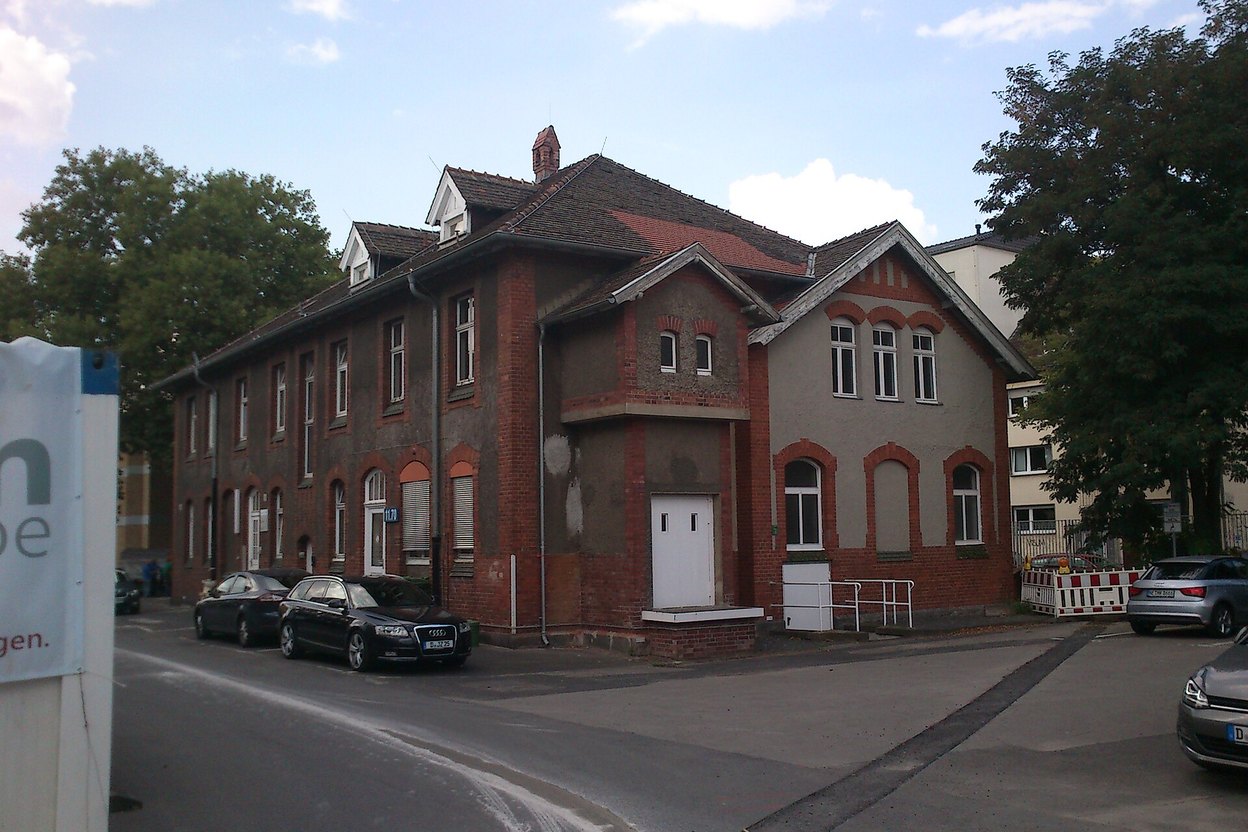
University Hospital Duesseldorf (UKD) is the university hospital in the south of Düsseldorf, with about 60 clinics and institutes. Each year it treats more than 45,000 patients as inpatients and 270,000 as outpatients; with its subsidiaries it employs about 9,300 people, and in 2023 it had 1,003 beds in operation.
This page covers the hospital’s history, departments, doctors, rooms and travel, and how AlenMed arranges treatment here. Other city hospitals are compared in our overview of hospitals in Düsseldorf.
History: from the 1907 municipal hospitals to a university hospital
University Hospital Duesseldorf grew out of the city’s general hospitals, opened in 1907, the year the Academy for Practical Medicine was also founded. Their first director, who also ran the academy, was the surgeon Oskar Witzel. The paediatrician Arthur Schlossmann headed the children’s clinic, and from September 1907 Otto Lubarsch led the pathology institute.
Heart surgery under Ernst Derra flourished in the new surgical building completed in 1958; the hospital counts the first operation in Germany with a heart-lung machine, performed under Derra, among its milestones. In 1965 the University of Düsseldorf was founded, with the academy as its medical faculty. In 1973 the state of North Rhine-Westphalia took over the hospitals, renamed the Medical Institutions of the University of Düsseldorf.
Clinics and departments
UKD’s clinics and institutes cover most medical specialties, from paediatrics to dentistry. Several clinics care for the heart and blood vessels: cardiologists treat arrhythmias, heart failure and coronary artery disease, pulmonologists treat lung diseases, and angiologists treat diseased arteries and veins without surgery. Cardiac surgeons operate on faulty valves and narrowed coronary arteries (see heart surgery in Germany). Vascular surgeons operate openly or endovascularly: from inside the vessel, through a thin catheter inserted via a small puncture, without a large incision.
- General Paediatrics, Neonatology and Paediatric Cardiology (Klinik für Allgemeine Pädiatrie, Neonatologie und Kinderkardiologie)
- General, Visceral and Paediatric Surgery (Klinik für Allgemein-, Viszeral- und Kinderchirurgie)
- Ophthalmology (Klinik für Augenheilkunde)
- Dermatology (Klinik für Dermatologie)
- Endocrinology and Diabetology (Klinik für Endokrinologie und Diabetologie)
- Gynaecology and Obstetrics (Klinik für Frauenheilkunde und Geburtshilfe)
- Gastroenterology, Hepatology and Infectious Diseases (Klinik für Gastroenterologie, Hepatologie und Infektiologie)
- Vascular and Endovascular Surgery (Klinik für Gefäß- und Endovaskularchirurgie)
- Ear, Nose and Throat Medicine (Klinik für Hals-Nasen-Ohrenheilkunde)
- Haematology, Oncology and Clinical Immunology (Klinik für Hämatologie, Onkologie und Klinische Immunologie)
- Cardiac Surgery (Klinik für Herzchirurgie)
- Cardiology, Pulmonology and Angiology (Klinik für Kardiologie, Pneumologie und Angiologie)
- Paediatric Oncology, Haematology and Clinical Immunology (Klinik für Kinder-Onkologie, -Hämatologie und Klinische Immunologie)
- Oral, Maxillofacial and Plastic Facial Surgery (Klinik für Mund-, Kiefer- und Plastische Gesichtschirurgie)
Adults with blood diseases and tumours are treated in the haematology and oncology clinic, children in the paediatric oncology clinic; options include chemotherapy and blood stem cell transplants (see treatment of blood disorders). Transplants are prepared by the Institute for Transplantation Diagnostics and Cell Therapeutics (ITZ), whose laboratory compares the tissue markers (HLA) of donor and patient to find a compatible donor. The closer the match, the better the chance that the body accepts the donor’s cells, as the US National Cancer Institute explains.
Doctors and leadership
The hospital is run by a board chaired by its Medical Director, Professor Kirsten Schmieder, and each clinic and institute has its own head. Dr. Johannes Fischer heads the ITZ. Patients from abroad reach the right specialist through a request: their reports and scans go to the relevant clinic, whose doctors decide whether to admit them for a consultation, tests or inpatient treatment.
Rooms, meals, visits and getting there
Single and double rooms are available for an extra charge (Wahlleistung), with extras such as free telephone, TV, radio, internet and a choice of meals; the cost estimate shows what the surcharge covers. In most clinics a bedside multimedia unit offers TV, radio and internet. The kitchen offers several menus daily; diets follow the doctor’s orders, and food intolerances can be considered. Each clinic sets its own visiting hours; patients and relatives can use the cafeterias, the chapel and a quiet room, and the foyer of the ZOM II building has a book-swap shelf.
Public transport is the easiest way to the campus: tram 704 runs from the main railway station to the «Uni-Kliniken» stop, also served by U-Bahn lines U72 and U73, and at Bilk S-Bahn station you can change to these lines or to buses 835 and 836. Paid parking is available on the grounds. From Düsseldorf Airport, take a taxi or public transport; the hospital’s invitation names the building where the patient is expected.
Frequently asked questions
How much does treatment at University Hospital Duesseldorf cost?
There is no fixed price: the hospital calculates the cost in an estimate once its doctors have reviewed the patient’s reports, scans and test results. The estimate lists examinations, treatment and the hospital stay; the surcharge for a single or double room is shown separately. The patient pays the hospital directly, starting with a deposit.
Can I choose my doctor at University Hospital Duesseldorf?
Yes, for an extra charge under a separate agreement. In Germany, treatment by a doctor of your choice, usually the head of the clinic or a deputy, is an optional medical service agreed separately from the main contract; without it, the department’s medical team cares for you. You can name a preferred doctor in your request, but the hospital decides on admission.
Can relatives visit the patient?
Yes, during visiting hours, which each UKD clinic sets for itself, so check them in advance. On the grounds, relatives can use the cafeterias, the chapel and a quiet room. AlenMed helps family members find accommodation near the campus, and a medical interpreter attends appointments, so the family understands what the doctor says.
How AlenMed arranges treatment at University Hospital Duesseldorf
AlenMed prepares your request to the right UKD clinic and organises every stage. You send medical reports, MRI or CT scans and lab results; we translate them into German and forward them to the relevant clinic, which replies with a preliminary treatment plan and a cost estimate (Kostenvoranschlag). If you only need an outpatient appointment, see English-speaking doctors in Germany; the full process is explained under arranging treatment in Germany.
Patients pay University Hospital Duesseldorf directly; after the deposit, the hospital issues the visa invitation. We arrange a medical interpreter for appointments, airport pickup and accommodation. AlenMed’s office is in Munich, and its partner clinics are across Germany.
This material is for reference only and is not an offer; the treatment plan is decided by a doctor at an in-person consultation.