 EN
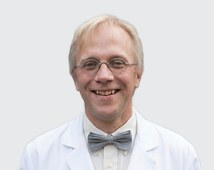
Dr Johannes Fischer is director of the Institute for Transplantation Diagnostics and Cell Therapeutics (Institut für Transplantationsdiagnostik und Zelltherapeutika, ITZ) at University Hospital Düsseldorf. His institute supplies the hospital with blood products, prepares stem cell grafts and matches donors by tissue type. People prone to bleeding or thrombosis are treated at its coagulation clinic, and patients with haemophilia at the haemophilia centre attached to it.
What Dr Fischer treats
Dr Fischer heads the institute responsible at the hospital for blood and blood products, stem cell grafts and tissue typing, which also treats clotting disorders. The institute offers:
- treatment for a tendency to bleed or to develop thrombosis, on referral from doctors of many specialties;
- a certified haemophilia centre treating haemophilia A and B, including haemophilia with inhibitors (antibodies against the clotting factor), and severe von Willebrand disease;
- outpatient transfusions for anaemia and low platelet counts, for example after chemotherapy;
- bloodletting and erythrocytapheresis for polycythaemia vera (too many red cells) and haemochromatosis (iron overload);
- training for patients on long-term Marcumar (an anticoagulant) to check their own clotting;
- tissue typing (HLA testing) before stem cell, kidney, cornea and heart transplants.
For background, see our page on haematology in Germany.
Training and experience
Dr Fischer studied medicine in Freiburg, Tübingen and Bonn (1984–1991) and began as a junior doctor in haematology/oncology and intensive care at University Clinic Bonn. In 1995 he became head of apheresis (collecting blood cells by machine) at the ITZ, and in 2001 he completed his doctoral thesis on cord blood transplants. He became associate director in 1999, was interim director from 2007 and has headed the institute since September 2016.
The department and hospital
In 2016 the ITZ was merged with the Institute for Haemostaseology, Haemotherapy and Transfusion Medicine. Its blood donation and transfusion centres supply blood products to all of the hospital’s patients around the clock. The bone marrow donor centre and the José Carreras stem cell bank belong to the institute, and its donation unit produces about 350 stem cell grafts a year. The HLA laboratory is accredited by the American Society for Histocompatibility and Immunogenetics (ASHI). The institute is part of University Hospital Düsseldorf.
Frequently asked questions
What conditions does Dr Fischer treat?
Dr Fischer’s institute mainly treats clotting disorders: a tendency to bleed or to develop thrombosis, haemophilia and severe von Willebrand disease. It gives outpatient transfusions for anaemia and low platelet counts and performs bloodletting for polycythaemia vera and haemochromatosis. Before a stem cell or organ transplant, its laboratory checks the tissue match.
How can I see Dr Fischer from abroad?
Gather your medical records and test results, including clotting tests. AlenMed translates them into German and forwards your request to University Hospital Düsseldorf, which confirms a date. Patients come to the coagulation clinic on referral from doctors of various specialties; the hospital decides which of the institute’s doctors sees you.
How much does treatment with Dr Fischer cost?
The exact amount is set by the hospital in a written estimate (Kostenvoranschlag) prepared before you travel. It depends on the examinations and treatment: a consultation at the coagulation clinic, a course of transfusions or bloodletting and tissue typing are priced differently. Payment goes directly to the hospital.
How to see Dr Fischer through AlenMed
AlenMed translates your medical records and test results into German, agrees a date with the hospital and, if needed, arranges a medical interpreter and personal support. To start, send a request through our form.
This information is for reference only and is not an offer. A doctor decides whether and how to treat after an in-person examination.