 EN
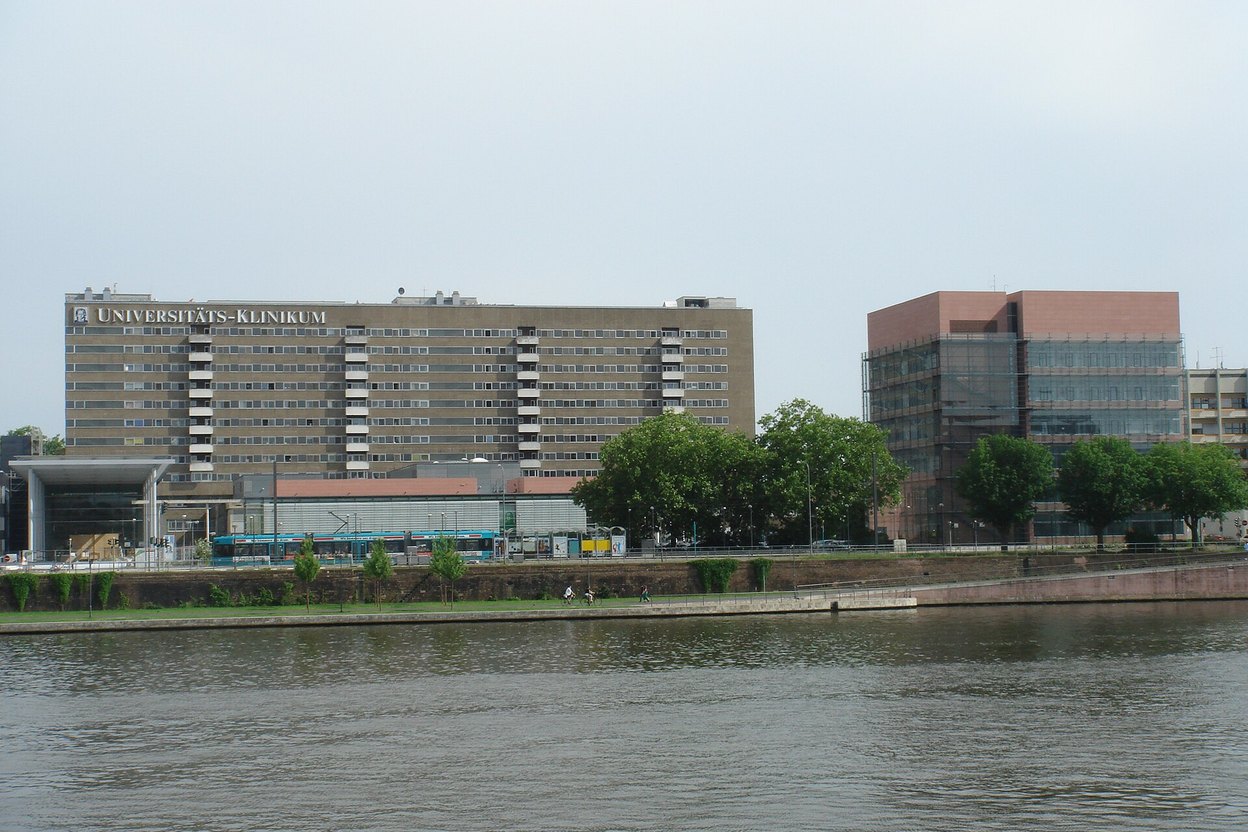
University Hospital Frankfurt am Main (Universitätsklinikum Frankfurt) is a university hospital in Frankfurt, Germany: a public-law institution of the State of Hesse attached to Goethe University, operating under the brand Universitätsmedizin Frankfurt, with more than 1,356 beds plus 237 day-clinic places. It treats patients, trains future doctors and carries out research.
The campus lies on the south bank of the Main along Theodor-Stern-Kai. Below are its history, departments, doctors and directions, and the route for patients from abroad; for comparison, see our overview of university hospitals in Germany.
History: from the Carolinum to Goethe University
The Frankfurt university hospital in Germany grew out of institutions older than the university itself. In 1890 the Carolinum was founded, a Rothschild family foundation that grew into today’s university dental centre. In 1899 the Royal Institute for Experimental Therapy opened in Frankfurt under Paul Ehrlich; the history of the Paul-Ehrlich-Institut goes back to it. In the early twentieth century the city council planned an Academy for Practical Medicine, but the plan failed in 1905; Mayor Franz Adickes and the industrialist Wilhelm Merton campaigned for years for something bigger: a university.
On 28 September 1912 the founding agreement of the Royal University of Frankfurt am Main was signed. The money came from local foundations and donors, many of them from Frankfurt’s Jewish families. In 1914 the university and its medical faculty began work, and the Sachsenhausen municipal hospitals became the faculty’s hospital.
Departments and centres
University Hospital Frankfurt has 33 medical clinics and institutes; some are listed below with the German names used on the hospital’s website:
- Ophthalmology (Klinik für Augenheilkunde)
- Dermatology, Venereology and Allergology (Klinik für Dermatologie, Venerologie und Allergologie)
- Gynaecology and Obstetrics (Klinik für Frauenheilkunde und Geburtshilfe)
- Ear, Nose and Throat Medicine (Klinik für Hals-, Nasen-, Ohrenheilkunde)
- Paediatrics and Adolescent Medicine (Klinik für Kinder- und Jugendmedizin)
- Centre for Intensive Care Medicine (Zentrum für Intensivmedizin Frankfurt, ZIF)
- Centre for Congenital Malformations (Zentrum für Angeborene Fehlbildungen)
- Centre for Molecular Medicine (Zentrum für Molekulare Medizin)
- Institute of General Practice (Institut für Allgemeinmedizin)
- Institute of Occupational, Social and Environmental Medicine (Institut für Arbeits-, Sozial- und Umweltmedizin)
- Institute of Legal Medicine (Institut für Rechtsmedizin)
For patients from abroad, the centres where several specialties work together matter most. At the Centre for Congenital Malformations, part of the paediatric clinic, children born with malformations, some detected before birth by ultrasound, are treated jointly by surgeons of several specialties and by eye, ENT and skin specialists, while a dedicated paediatrician supports the family. The Centre for Intensive Care Medicine works around the clock; the directors of neurology, neurosurgery, cardiology and trauma surgery, introduced below, sit on its board. Cancer care has its own page on cancer treatment in Frankfurt.
Doctors at University Hospital Frankfurt
University Hospital Frankfurt is headed by Prof. Dr. Jürgen Graf, medical director and chairman of the executive board. The board also includes the heads of nursing and of commercial management and the dean of the medical faculty.
Prof. Bastian Schilling is director of the Department of Dermatology, Venereology and Allergology. Prof. Christian Grefkes-Hermann directs the Department of Neurology and also leads the Centre for Intensive Care Medicine as its medical head and the spokesperson of its board.
The centre’s board also brings together the directors of other departments: Prof. Marcus Czabanka for neurosurgery, Prof. Ingo Marzi for trauma surgery and orthopaedics, and Prof. David Leistner for cardiology and angiology. Prof. Marzi is also the hospital’s deputy medical director.
Location and getting there
University Hospital Frankfurt, Germany, stands on the south bank of the Main along Theodor-Stern-Kai, in the districts of Niederrad and Sachsenhausen-Nord. The airport and the central station are close: the nearest underground and S-Bahn stations are the central station (Hauptbahnhof), Südbahnhof and Niederrad, from where trams run to the Universitätsklinikum stop at the main entrance; from Frankfurt Airport, travel via the central station or Südbahnhof. The invitation states the building and ward you need.
Rooms are allocated on organisational grounds; a single or double room can be booked for an extra charge as an optional service (Wahlleistung). Patients choose the next day’s lunch from several dishes, can ask the nurses for a special diet or a dietitian, and have free Wi-Fi on campus. Relatives are welcome, even on intensive care wards. If you are comparing hospitals in Frankfurt, also look at Bürgerhospital Frankfurt, a separate hospital in the city.
Frequently asked questions
Does University Hospital Frankfurt accept patients from abroad?
Yes. Its International Office prepares a cost estimate in English or German, issues an invitation for the embassy after the advance payment and can arrange an interpreter by separate agreement, for a fee. Doctors first review discharge letters, test results and scans, so send the documents in advance, ideally translated into German.
How much does treatment at University Hospital Frankfurt cost?
There is no fixed price: the cost depends on the diagnosis and the scope of examinations and treatment. The hospital calculates it in a cost estimate (Kostenvoranschlag) after reviewing the documents, and self-paying patients pay in advance. Optional services, such as a chosen physician or a single or double room, are charged separately and agreed in writing.
How many beds does University Hospital Frankfurt have?
The hospital’s figures for 2025 show more than 1,356 beds plus 237 day-clinic places in 33 medical clinics and institutes. Including the medical faculty and subsidiaries, more than 8,500 people work there; more than 50,000 patients were treated as inpatients that year, and outpatient cases came to almost 500,000.
How AlenMed arranges treatment in Frankfurt
AlenMed prepares your medical documents, translates them into German and sends the request to the department of the university hospital that deals with your diagnosis. We need discharge letters, test results and MRI or CT images; from these the hospital’s doctors decide whether you should come and what to offer.
The hospital then sends a cost estimate (Kostenvoranschlag) with the plan and expected cost. Once the deposit has reached its account, the hospital issues an invitation for your medical visa, which our visa support helps you obtain, and an interpreter is with you at consultations. AlenMed’s office is in Munich and our partner hospitals are spread across Germany; the cost of treatment in Germany is explained on a separate page.
This material is for reference only and is not an offer. The hospital sets the scope, timing and cost of treatment after reviewing the documents, and the treatment plan is decided by a doctor at an in-person consultation.