 EN
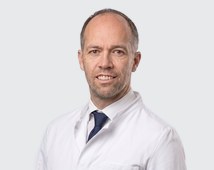
Dr Thomas Ferbert is a senior consultant in the Department of Trauma and Reconstructive Surgery at Heidelberg University Hospital and heads its nonunion surgery section. Patients see him when a broken bone fails to heal and an often painful and frequently infected false joint forms at the fracture site.
What Dr Ferbert treats
Dr Ferbert is a specialist in orthopaedics and trauma surgery. A nonunion develops when fracture healing is disrupted, often by infection or poor blood supply, as in diabetes or smokers. His department offers:
- contrast-enhanced ultrasound and special MRI to assess blood supply and infection;
- the two-stage Masquelet technique: diseased bone is replaced by a cement spacer, and a second operation rebuilds the gap;
- bone grafts from the pelvis or thigh and modern bone substitutes;
- fixation with plates, screws, intramedullary nails and external fixators.
He also writes expert reports (Gutachten) for courts and insurers. More on trauma surgery and orthopaedics.
Training and experience
Thomas Ferbert studied chemistry in Würzburg in 2005, then medicine in Szeged, Hungary, and at Heidelberg University’s Mannheim faculty. Licensed in 2011, he completed his doctorate magna cum laude at Mannheim’s Central Institute of Mental Health in 2012.
He has worked at Heidelberg University Hospital since 2012, qualifying as a specialist in 2019, becoming a senior physician in trauma and reconstructive surgery in 2021 and heading the nonunion section since October 2024. He holds a radiation protection qualification and is an ATLS (Advanced Trauma Life Support) provider.
The department and hospital
The department at Heidelberg University Hospital works at the Neuenheimer Feld campus and the Centre for Orthopaedics, Trauma Surgery and Paraplegiology in Schlierbach; at both sites its trauma centre is approved by German statutory accident insurance for the most severe injuries.
It specialises in failed and infected fracture treatment and, as a centre for fractures that will not heal, has performed more than 1,000 nonunion operations. Close cooperation with all hospital departments allows it to treat patients with serious coexisting illnesses.
Frequently asked questions
What conditions does Dr Ferbert treat?
Dr Ferbert mainly treats fractures that have not healed and formed a false joint, including after unsuccessful treatment or with infection or poor blood supply to the bone. His department also treats malunited and infected fractures, severe and multiple injuries and fractures in older people.
How can I see Dr Ferbert from abroad?
Gather reports on the fracture and operations, with X-ray, CT and MRI images and reports. AlenMed translates them into German and forwards your request; the hospital confirms a date and decides who will consult and operate. Healing sometimes takes 1–2 years; check-ups are planned at discharge.
How much does treatment with Dr Ferbert cost?
The exact amount is set by the hospital in a written estimate (Kostenvoranschlag) prepared before you travel. It depends on the examinations and treatment: a consultation, one operation and two-stage Masquelet treatment are priced differently. Payment goes directly to the hospital.
How to see Dr Ferbert through AlenMed
AlenMed translates your records into German, agrees a date for the consultation or operation and, if needed, arranges a medical interpreter and personal support. To start, send a request through our enquiry form.
This information is for reference only and is not an offer. A doctor decides whether and how to treat after an in-person examination.