 EN
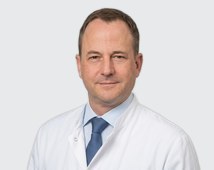
Professor Gerhard Schmidmaier is medical director of the Department of Trauma and Reconstructive Surgery (Klinik für Unfall- und Wiederherstellungschirurgie) at Heidelberg University Hospital. Patients see him with fractures of the pelvis, shoulder, forearm and hip, elbow and tendon injuries, and fractures that fail to heal.
What Professor Schmidmaier treats
Professor Schmidmaier leads general traumatology and medical assessment; his specialist areas are:
- pelvic ring fractures;
- shoulder and elbow injuries, forearm fractures;
- thigh bone fractures near the hip;
- tendon ruptures;
- polytrauma, severe multiple injuries that threaten life;
- pseudarthrosis, a false joint where a broken bone has not healed.
He also writes expert reports for courts and insurers. See our trauma surgery and orthopaedics pages.
Training and experience
Gerhard Schmidmaier studied medicine at the Technical University of Munich (1990–1997), earning his doctorate there in 1999. From 1997 he worked in trauma surgery at Charité in Berlin: as a research fellow, from 2003 as senior physician and in 2006–2010 as lead trauma surgeon. He completed his habilitation, the German professorial qualification, in surgery in 2004 and became an adjunct professor at Charité in 2009.
He is a specialist in surgery (2002) and in orthopaedics and trauma surgery (2008), with an additional qualification in special trauma surgery. Since 1 February 2010 he has headed trauma surgery in Heidelberg and leads the Heidelberg Trauma Research Group. He belongs to the German Trauma Society (DGU) and its guidelines committee.
The department and hospital
The department at Heidelberg University Hospital works at two sites, the Neuenheimer Feld campus and the orthopaedic and trauma centre in Schlierbach, both approved for the most severe accident injuries (SAV). Neuenheimer Feld focuses on multiple injuries, treated with anaesthetists and surgeons; the department also specialises in failed fracture treatment and infected fractures.
It also treats injuries in children and older people, fractures around implants, and ankle and foot injuries, using antibiotic-coated nails, external fixators, post-traumatic joint replacement and the Masquelet technique for false joints. Links with all university hospital departments allow treating patients with serious other illnesses.
Frequently asked questions
What conditions does Professor Schmidmaier treat?
Professor Schmidmaier treats fractures of the pelvis, shoulder, forearm and hip, elbow injuries, tendon ruptures and fractures that have not healed. His department also treats severe multiple injuries, infected fractures and injuries in older people.
How can I see Professor Schmidmaier from abroad?
Prepare treatment reports, operation notes and X-ray, CT or MRI images with reports. AlenMed translates them into German and forwards your request; the hospital confirms a date. Although the professor runs a private clinic, the hospital decides who sees you and operates.
How much does treatment with Professor Schmidmaier cost?
The exact amount is set by the hospital in a written estimate (Kostenvoranschlag) prepared before you travel. It depends on the examinations and treatment: a consultation, false-joint surgery and treatment of an infected fracture are priced differently. Payment goes directly to the hospital.
How to see Professor Schmidmaier through AlenMed
AlenMed translates your records into German, agrees a date with the hospital and, if needed, arranges a medical interpreter and personal support. To start, send a request through our form.
This information is for reference only and is not an offer. A doctor decides whether and how to treat after an in-person examination.