 EN
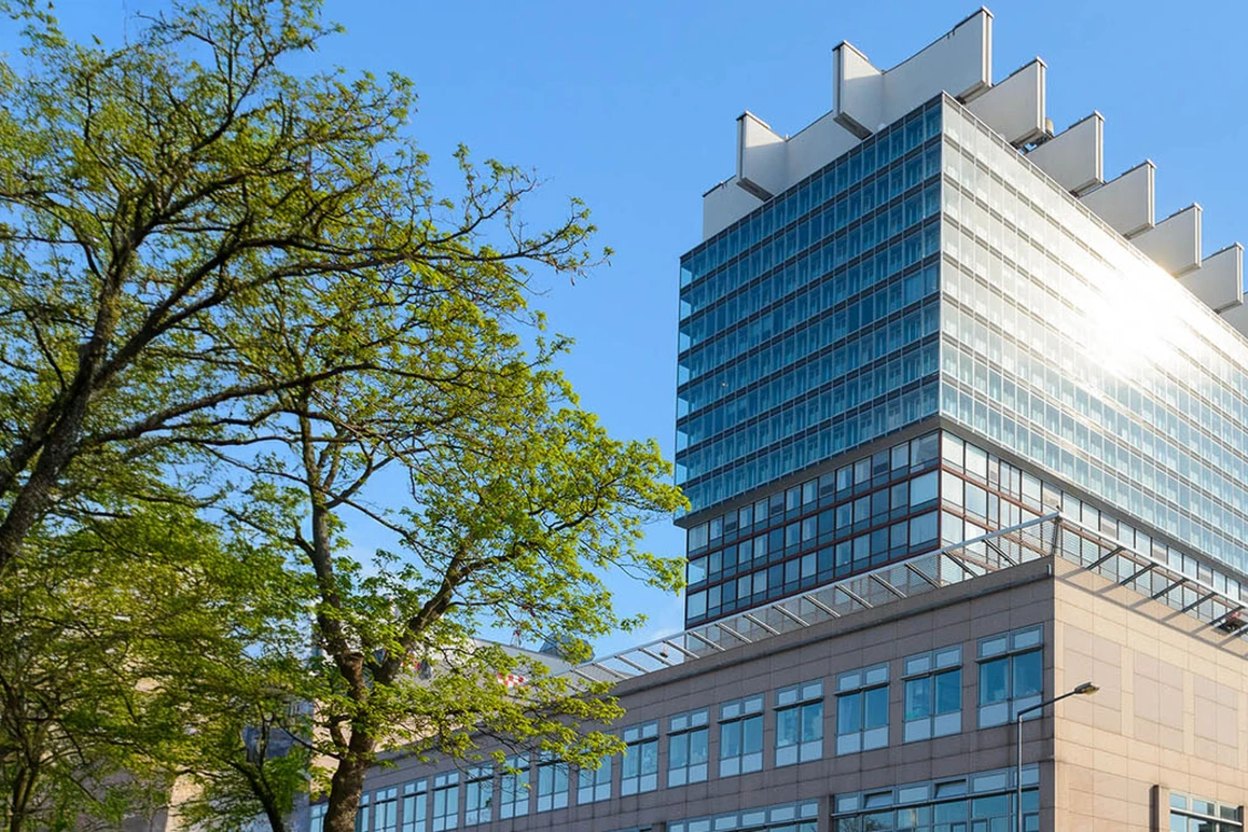
Cologne University Hospital (Uniklinik Köln) is a maximum-care hospital (Krankenhaus der Maximalversorgung) of the University of Cologne’s medical faculty, with 1,522 beds on its campus in the Lindenthal district. «Maximum care» is the highest level of the German hospital system: such hospitals take the most complex cases, and a university hospital also does research and trains doctors.
For a patient from abroad, what matters more is that clinics, laboratories and research institutes share one campus, so specialists from several fields can review a complex case together. A separate overview explains how university hospitals in Germany differ from general hospitals.
History: From Albertus Magnus to a University Hospital
The story of university medicine in Cologne runs from a medieval Dominican school to a municipal hospital that became a university hospital in 1919. In 1248 the Dominican Albertus Magnus came to Cologne to help found the order’s school of higher learning, regarded as a forerunner of the university. The university itself was founded in 1388 and had a medical faculty from the start. In 1798 this «old» university was closed by order of Napoleon.
In 1904 the city opened its Academy for Practical Medicine, the first of its kind in Germany. In 1919 the university was re-founded as a municipal institution at the initiative of Lord Mayor Konrad Adenauer: the academy became its medical faculty, and the city handed its hospital over to the faculty.
Centres and Institutes of Uniklinik Köln
Besides its clinical departments, Uniklinik Köln runs specialised centres and research institutes, among them:
- Centre for Operative Paediatric Medicine (Zentrum für Operative Kindermedizin)
- Centre for Molecular Medicine (Zentrum für Molekulare Medizin)
- Institute for Biomedical Informatics (Institut für Biomedizinische Informatik)
- Centre for Clinical Trials (Zentrum für Klinische Studien, ZKS)
- Centre for Neurosurgery (Zentrum für Neurochirurgie)
- Centre for Palliative Medicine (Zentrum für Palliativmedizin)
The Centre for Neurosurgery operates on the brain and spinal cord; a separate page describes neurosurgery in Germany in general. The Centre for Operative Paediatric Medicine operates on children with congenital and acquired conditions. The Centre for Palliative Medicine relieves pain, breathlessness and other distressing symptoms in severe, incurable illness. Palliative care does not mean giving up treatment: it can be given alongside therapy for the illness itself.
The Centre for Clinical Trials (ZKS) helps doctors plan and run studies of new medicines and treatments. A patient may be offered a place in a trial if their illness and condition meet the criteria of a specific study; the decision is theirs alone. Eye diseases are treated at a separate centre, the Eye Center at Uniklinik Köln. How to find a specialised cancer centre in Germany is explained, in German, by the Cancer Information Service of the German Cancer Research Center.
Clinic and Institute Directors
Each clinic and institute has its own director. The Department of Dermatology and Venereology (Klinik und Poliklinik für Dermatologie und Venerologie) is headed by Prof. Esther von Stebut, the Department of Gastroenterology and Hepatology (Klinik und Poliklinik für Gastroenterologie und Hepatologie) by Prof. Christoph Neumann-Haefelin, and the Department of Paediatrics and Adolescent Medicine (Klinik und Poliklinik für Kinder- und Jugendmedizin) by Prof. Jörg Dötsch.
The Institute for Translational Research at CECAD (Institut für Translationale Forschung, CECAD) is directed by infectious disease specialist Prof. Oliver Cornely. Prof. Florian Klein heads the Institute of Virology (Institut für Virologie), Prof. Jonathan Jantsch the Institute for Medical Microbiology, Immunology and Hygiene (Institut für Medizinische Mikrobiologie, Immunologie und Hygiene), and Prof. Beate Müller the Institute of General Practice (Institut für Allgemeinmedizin). Which doctor reviews a patient’s records is decided by the specialist department.
Getting There and Facilities on Campus
The Cologne hospital campus in Lindenthal can be reached by tram or bus, and drivers can use the hospital’s multi-storey car parks (Parkhaus). The campus has many buildings, so the exact address of the right one and directions are sent with the invitation.
On site there is a cafeteria, a kiosk and a park, and relatives can visit patients. Room options and extra services are specified in the hospital’s estimate. Uniklinik Köln is only one among the hospitals in Cologne, Germany; an overview of the others is on a separate page.
Frequently asked questions
How much does treatment at Cologne University Hospital cost?
There is no single price: the cost depends on the diagnosis, the tests needed and whether surgery or an inpatient stay is required. After reviewing the medical records, the hospital prepares a cost estimate (Kostenvoranschlag) that lists the planned services and their prices. Payment goes directly to the hospital’s account.
How can I get treatment at Cologne University Hospital from abroad?
The first step is your medical records: discharge letters, lab results and CT or MRI scans on disc. They are translated into German and sent to the relevant department, whose doctors give a preliminary assessment and suggest a plan for tests or treatment. The hospital then issues a cost estimate and an invitation for the visa application. AlenMed arranges all of these steps.
Can I take part in a clinical trial at Cologne University Hospital?
It is possible if your illness and condition meet the criteria of a specific trial. Your treating doctor may suggest a suitable study. Taking part is always voluntary: the doctor explains the aims, possible benefits and risks, you decide whether to sign the consent form, and you can withdraw at any time without it affecting your care.
Where is Cologne University Hospital located?
The hospital occupies a large campus in Cologne’s Lindenthal district, served by trams and buses and with multi-storey car parks for drivers. Its departments are housed in separate buildings, so the exact address of the right building and directions are sent with the invitation.
How AlenMed Arranges Treatment at Cologne University Hospital
AlenMed takes care of the paperwork, the correspondence with the hospital and the travel arrangements. You send discharge letters, lab results and CT, MRI or PET-CT scans on disc; AlenMed has them translated into German, passes them to the right department and obtains the doctors’ preliminary assessment of the tests and treatment they propose.
Based on that assessment, the hospital draws up a cost estimate (Kostenvoranschlag), and payment is made directly to the hospital. The hospital also issues the invitation needed for a visa, and AlenMed’s medical visa support helps with the consular paperwork. An interpreter accompanies the patient at consultations and on ward rounds. The company’s office is in Munich.
This material is for reference only and is not an offer. The treatment plan is decided by the doctor at a face-to-face consultation.