 EN
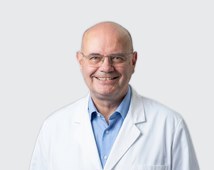
Dr Oliver Trapp is chief physician of the Department of Internal Medicine (Innere Medizin) at Asklepios Schlossberg Klinik in Bad König, Hesse. The hospital specialises in early neurological rehabilitation for people with severe brain damage, and Dr Trapp’s department treats these patients’ coexisting internal diseases and complications.
What Dr Trapp treats
Dr Trapp is an internist (specialist in internal medicine). His department treats coexisting internal diseases and complications in early rehabilitation patients and provides intensive care. Often the cause of the illness, such as a stroke, also has to be investigated. The department’s main areas are:
- endoscopy, examining organs from the inside with a flexible camera instrument;
- ultrasound examinations;
- monitoring and treatment of the heart, circulation and breathing;
- X-ray diagnostics.
See also our pages on internal medicine and neurology.
Training and experience
Dr Trapp is a specialist (Facharzt) in internal medicine with two additional qualifications (Zusatzbezeichnung): intensive care medicine (Intensivmedizin) and rehabilitation (Rehabilitationswesen).
In Hesse he is authorised to provide 18 months of specialist training in internal medicine and 9 months of additional training in intensive care medicine (WBO 2020).
The department and hospital
Asklepios Schlossberg Klinik in Bad König is an acute hospital (Akutklinik) and a certified neurological weaning centre, helping patients come off ventilators. It specialises in early neurological and neurosurgical rehabilitation after severe brain damage (phase B). It has 129 beds on 7 wards and more than 650 staff, and treats about 450–500 patients a year. Rehabilitation starts early, alongside intensive care, to restore mobility and independence in daily life.
The hospital has offered early neurological rehabilitation since 1989, as one of the first in Germany, and since its extension in 2011 it has been the largest facility of its kind in Hesse (according to the hospital). For patients needing intensive monitoring or treatment on admission, and for complications, there are 43 intensive care and 86 intermediate care (IMC) beds. The intensive care department offers ventilator weaning, kidney replacement therapy and plasmapheresis.
Frequently asked questions
What conditions does Dr Trapp treat?
Dr Trapp treats early rehabilitation patients with coexisting internal diseases or complications, including heart, circulation and breathing problems. The hospital admits people with severe brain damage from impaired blood supply to the brain or bleeding, accidents, lack of oxygen, poisoning, inflammation or tumours.
How can I see Dr Trapp from abroad?
To assess an admission, the hospital asks for medical records with the diagnoses and a current Barthel index, a scale rating independence in daily activities. AlenMed translates the documents into German and forwards the request; the hospital decides on admission and the date, and which of its doctors will care for the patient.
How much does treatment with Dr Trapp cost?
The exact amount is set by the hospital in a written estimate (Kostenvoranschlag) prepared before travel, so costs are known in advance. It depends on the patient’s condition, the examinations and treatment needed and the length of stay. Payment goes directly to the hospital.
How to see Dr Trapp through AlenMed
AlenMed translates medical reports into German, agrees an admission date with the hospital and, if needed, arranges a medical interpreter and personal support. To start, send a request through our form.
This information is for reference only and is not an offer. A doctor decides whether and how to treat after an in-person examination.