 EN
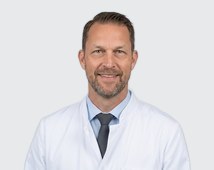
Professor Arne Berner is chief physician of the Department of Orthopaedics, Trauma Surgery, Shoulder Surgery and Joint Replacement (Klinik für Orthopädie, Unfallchirurgie, Schulterchirurgie und Endoprothetik) at RHÖN-KLINIKUM Campus Bad Neustadt, which he heads jointly with Professor Andre Steinert. Patients see him about injuries, including work accidents, shoulder and elbow problems and sports injuries.
What Professor Berner treats
Professor Berner is an orthopaedic and trauma surgeon, a certified shoulder and elbow surgeon and deputy head of his department’s shoulder and elbow centre, certified by the German Association for Shoulder and Elbow Surgery (DVSE). As a trauma specialist he is a D-Arzt, approved by Germany’s statutory accident insurance to treat injuries from work, school or the journey there. Operations there include:
- rotator cuff surgery (the tendons that hold and turn the shoulder);
- treatment of shoulder instability and frozen shoulder;
- surgery for shoulder and elbow osteoarthritis, including elbow replacement;
- treatment of shoulder girdle and elbow fractures and their after-effects;
- surgery for a locking or unstable elbow.
Shoulder and elbow operations are planned on a computer from CT data, with 3D imaging and navigation available during surgery. See also our pages on orthopaedics and trauma surgery.
Training and experience
Professor Berner is a specialist (Facharzt) in orthopaedics and trauma surgery with qualifications in special trauma surgery (Spezielle Unfallchirurgie), special orthopaedic surgery (Spezielle Orthopädische Chirurgie), sports medicine and emergency medicine. He holds a PhD and is an ATLS instructor for severe injuries; his publications include an article on fractures that fail to heal (pseudarthrosis) in Der Chirurg.
He is a member of the German societies for trauma surgery (DGU), orthopaedics and trauma surgery (DGOU), shoulder and elbow surgery (DVSE) and of the German-speaking arthroscopy association (AGA). His department was formed in 2019 by merging the shoulder surgery department with the trauma surgery and joint replacement department, with Professor Steinert and Professor Berner as chief physicians.
The department and hospital
The department treats diseases and injuries of the musculoskeletal system. Its main areas are joint replacement, with a certified joint replacement centre, trauma surgery, shoulder and elbow surgery, and sports orthopaedics. Germany’s statutory accident insurance (DGUV) has approved it to treat severely injured patients after work-related accidents.
It treats injuries of every severity, including pelvic and spinal fractures and injuries in children, with a helipad, resuscitation rooms, X-ray, CT and MRI and an emergency service around the clock. It is part of Rhön-Klinikum Campus Bad Neustadt, where RHÖN-KLINIKUM AG runs specialist hospitals and a general hospital with around 1,700 beds.
Frequently asked questions
What conditions does Professor Berner treat?
Professor Berner treats fractures and other injuries and their after-effects, including fractures that have not healed, sports injuries, and shoulder and elbow disorders such as rotator cuff tears, dislocations and osteoarthritis. His department also replaces hip, knee and shoulder joints.
How can I see Professor Berner from abroad?
Prepare recent X-rays, previous operation reports and doctors’ letters – the department asks for these, for example, when a fracture has not healed. AlenMed translates the documents into German and forwards your request; the hospital confirms a date and decides which of its doctors sees you and operates.
How much does treatment with Professor Berner cost?
The hospital sets the amount in a written estimate (Kostenvoranschlag) prepared before you travel, so you know the costs in advance. It depends on the examinations and treatment: arthroscopy, joint replacement and surgery for a non-healing fracture are priced differently. Payment goes directly to the hospital.
How to see Professor Berner through AlenMed
AlenMed translates your records and imaging reports into German, agrees a date with the hospital and, if needed, arranges a medical interpreter and personal support. To start, send a request through our form.
This information is for reference only and is not an offer. A doctor decides whether and how to treat after an in-person examination.